
Imagine a couple has finally picked a date and found your website. They fill out your inquiry form while you’re on a venue walkthrough. They also filled out 5 other inquiry forms with your competitors. Later, you sit down to check for new leads and your inbox won’t load.
Where else would you look for that inquiry?
On November 12, 2026, a Microsoft outage disrupted Outlook access for users across the U.S. for several hours. It got me thinking about how much of a wedding business can depend on being able to open one inbox.
What happens when your inbox doubles as your lead tracker?
Say your website form sends submissions to your inbox and email is the only place you can see them. If you lose access, you may have to wait to see who reached out, what date they’re asking about, or whether you already sent them pricing. Meanwhile, your competitors who use a customer relationship management solution like HoneyBook have one source of truth, one portal with all client data and documents. If their email goes down, they simply call the lead, or use a different email provider temporarily. They are never flying blind to new inquiries or to existing client communication.
And on a perfectly normal Monday? You open an inquiry between meetings, flag it for later, and move on. By the time you get back to your desk, it’s buried under a venue update, a timeline revision, and a dozen other messages. You remember the couple’s first name, so you search for it. Now you’re rereading a thread to figure out whether you’re waiting on them or they’re waiting on you.
That’s the everyday risk of running your inquiry process through email. The details and next steps are scattered across conversations, and you have to reconstruct them every time you sit down to follow up.
Give every inquiry a place to land
A CRM is a system for tracking client relationships. For a wedding business, one of its most useful jobs is showing you where each inquiry stands, from the first hello to a signed contract.
At Dog Of Honor®, my website inquiry form feeds into HoneyBook. When a couple submits the form, HoneyBook creates a project and sends an email notification. I can go straight to the pipeline to see the inquiry, even if I can’t open the email alert.
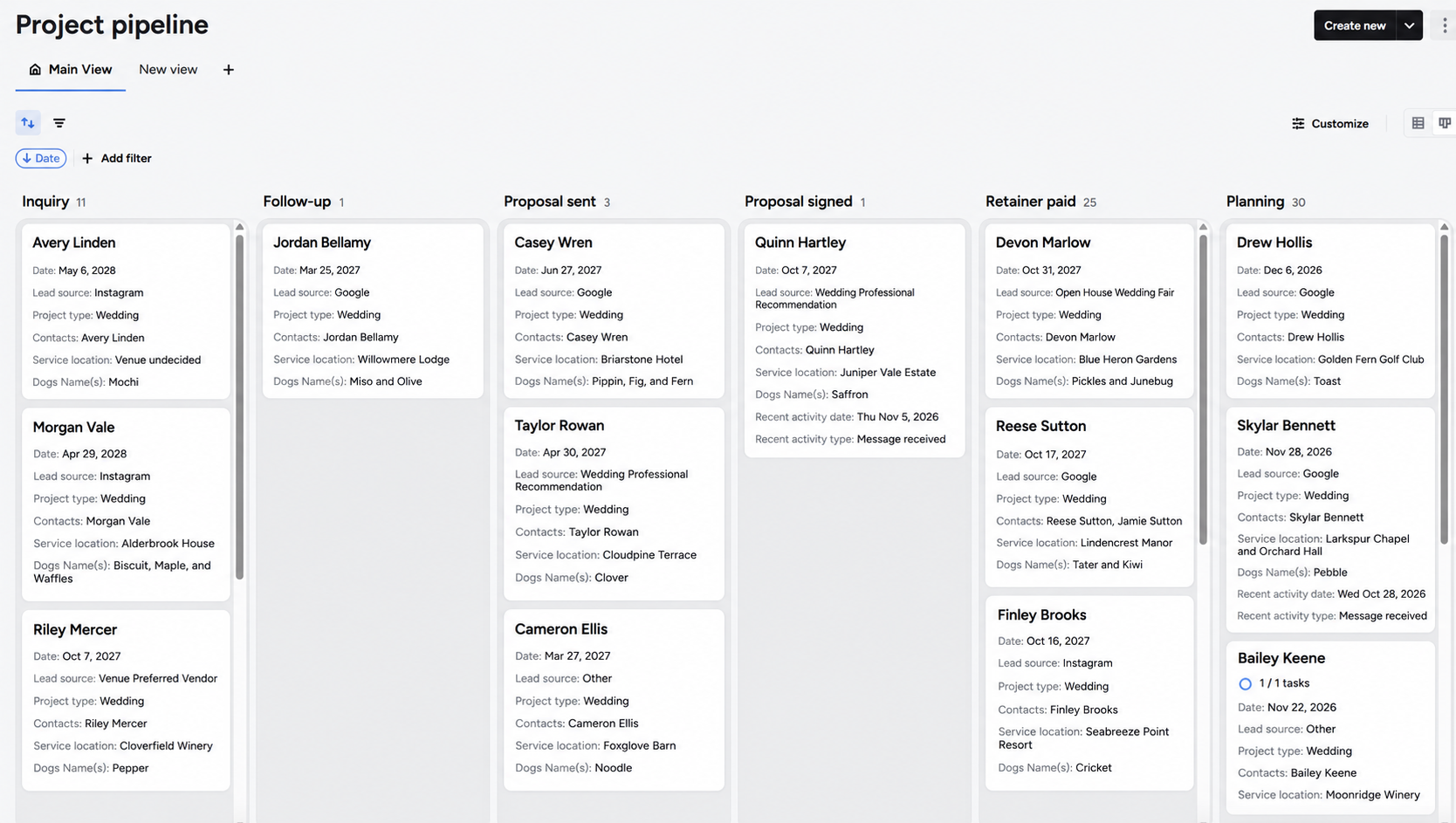
For example, a wedding photographer could open their pipeline on Monday and see which couples are waiting for a first reply, which have a consultation scheduled, and which already have a proposal. When a couple reaches out by email or Instagram, the photographer can add that lead to the same pipeline so the next step is easy to find.
The distinction matters during an outage. A CRM gives you another place to see inquiries so you never have one point of failure in your business. Without a CRM like HoneyBook, if someone emails you directly during an outage, you have to wait until you can access that message. Meanwhile, all the other professionals who received the same inquiry get a jump start on their responses. That’s why I start with the website form when I help wedding pros set up HoneyBook.
If you’d like help figuring out where to start, explore a HoneyBook Audit with Fetch & Flow. We’ll review your process and find opportunities to take repetitive work off your plate, so you have more time for the clients and work you love.
